7 Vendor Risk Metrics Examiners Demand
You can buy third party risk management software and still feel like youre herding cats through a car wash when the examiner asks, calmly, for proof that you know your vendors, your data, and your risks. The problem is not effort, you already have plenty of that. The problem is that the facts live in too many places, and the story never sounds the same twice.
If you run a community bank or sit in that lovable corner office where the hot seat rotates between compliance, IT, risk, audit, and the CEO, you know the drill: you need a clean way to understand, govern, and document your technology environment, including who your software vendors are, where AI shows up, what risk looks like, and how to print the kind of regulatory documentation that holds up in a bank examination. BankTechIntel exists in that exact lane, with an inventory approach that maps software vendors, identifies AI usage, evaluates technology risk, and generates the documentation exam teams ask for.
Once you see the exam the way the examiners see it, the whole thing gets less spooky and more mechanical, because they keep coming back to a small set of vendor risk metrics. Those metrics are the spine of your narrative, and your job gets easier when your inventory stays current instead of becoming that one spreadsheet named FINAL_FINAL_v9.xlsx.
TL;DR: The vendor metrics that stop the back and forth
- Examiners want proof you know who your vendors are, what they do, and what they touch.
- The cleanest answers come from a living inventory, not a once a year scramble.
- AI questions now show up inside normal vendor questions, so tracking AI usage matters even when the vendor is not an AI company.
- A risk rating without supporting evidence reads like a guess, so attach controls, incidents, and due diligence to the vendor record.
- Contracts, SLAs, and SOC reports matter more when you can show coverage, dates, and exceptions at a glance.
- The BankTechIntel AI inventory tool helps keep vendor and AI details organized so reporting lines up with what examiners ask for.
- The best posture is simple: current data, clear ownership, and repeatable documentation.
The sneaky trap in third party risk management software
Some tools make it feel like the job is done once you upload a bunch of PDFs, score a vendor, and click a workflow button, because hey, there are green checkmarks and a dashboard, right, but examiners usually follow evidence trails, not vibes, and they ask how you know the data stayed current. A tool can store documents, yet still leave you guessing about shadow SaaS, business owned apps, and that weird AI feature a vendor quietly added last quarter. One of the clean ways out is keeping a true inventory that ties vendors to systems, data types, and business owners, and that is where the BankTechIntel AI inventory tool can save hours of detective work.
That green dashboard can turn into a false calm. It happens fast. People rely on a score and forget the story behind the score.
A Tuesday afternoon that starts out normal
Picture the rhythm: you are mid week, the lobby smells like coffee, and someone has a plate of kolaches in the breakroom, then an email pops in from internal audit asking for your vendor list and the current risk ratings before the exam kickoff call. You pull the vendor spreadsheet, then the contract folder, then the ticketing system, and then you remember the marketing team signed up for a tool on a corporate card because it was only forty nine bucks a month. The CRO wants consistency, the CISO wants proof, the IT director wants to know what integrates where, and the CEO wants the whole thing to fit on one page.
Even if you are calm, your calendar is not. That is the moment when a clean, current inventory stops being a nice to have. It becomes the only way to answer quickly without hand waving.
When the examiner asks for metrics, not folders
Then the exam question lands, polite and sharp: show us how you measure vendor risk, how you track changes, and how you know your critical vendors meet your standards, and suddenly you are staring at five versions of the same vendor name across systems. You can feel the room shift, because you are not being asked whether you have documents, you are being asked whether your process works. The worst part is the tiny gaps, like an expired SOC report date or a missing data flow note, because those gaps eat time and confidence.
It can feel like you are trying to build a bridge while traffic is already on it. You keep thinking, if we just had one place where vendor, system, AI usage, risk notes, and exam ready documentation lived together, this would stop being a late night thing.
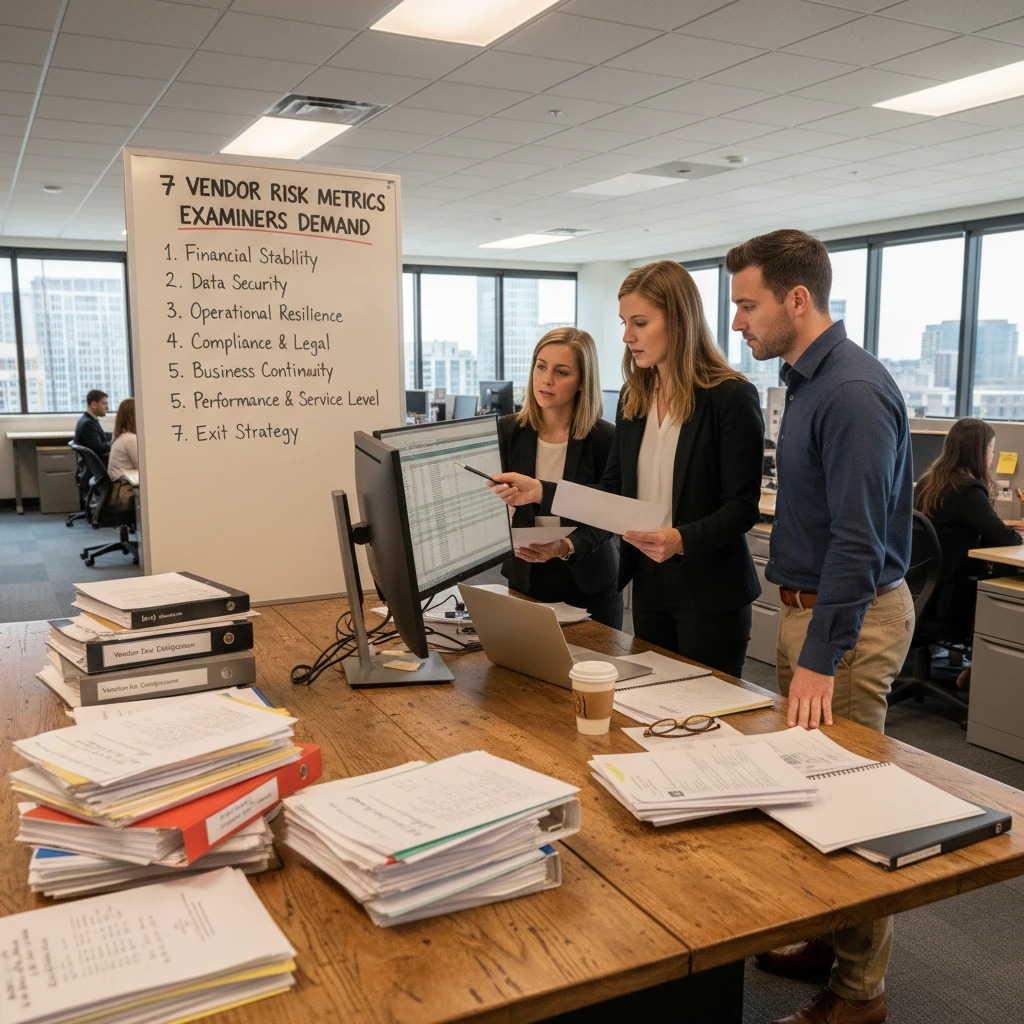
The seven metrics examiners keep circling back to
These are the vendor risk metrics that tend to show up again and again during bank examinations, and they get much easier to produce when your inventory stays updated, including AI usage, system connections, and ownership, which is exactly the kind of organization the BankTechIntel AI inventory tool is built to support.
One sentence answers do not cut it. Numbers plus context do.
- Vendor inventory completeness, meaning you can show the full list and explain how you find new vendors.
- Criticality tiers, meaning you can explain which vendors are critical and why, based on impact.
- Due diligence coverage, meaning what percent of vendors have current SOC reports, questionnaires, financials, and security reviews.
- Contract and SLA status, meaning renewal dates, service levels, and tracked exceptions.
- Issue and incident trends, meaning outages, security events, complaints, and remediation time.
- Access and data exposure, meaning which vendors touch NPI, credentials, or core connections, and how that access is controlled.
- Oversight cadence, meaning review frequency, board or committee reporting, and how changes trigger re review.
third party risk management software meets the exam reality
Once you map those metrics to your daily work, you start treating your tool as a system of record, not a file cabinet, and that is a different posture than just collecting documents. The practical move is tying each metric to a field you can keep current, like vendor owner, last review date, SOC report period, data types handled, and whether AI is used in the service. BankTechIntel focuses on understanding and documenting the technology environment, so the inventory itself becomes the backbone that feeds exam documentation without rewriting everything each time.
A lot of stress comes from reinventing the same report. A calmer week comes from reusing the same trusted record.
The plain language scorecard examiners can follow
When you need to show progress without drowning in detail, it helps to keep a small scorecard view that rolls up what matters most, because it turns a messy vendor universe into something you can defend in a meeting.
| Metric | What you show | What it proves |
|---|---|---|
| Inventory completeness | Vendor list with owners and systems | You know your environment |
| Critical vendor count | Tiering with rationale | You prioritize by impact |
| Current due diligence rate | % current SOC, security review, financials | Oversight is active |
| Contract and SLA coverage | Expirations, SLAs, exceptions | Obligations are tracked |
| Incident volume and closure time | Tickets and postmortems | Problems get managed |
| Data and access mapping | Data types, access method, controls | Exposure is understood |
| Review cadence | Review dates and triggers | The process repeats |
Make it readable. Make it consistent. The person across the table wants to see that your numbers and your narrative match.
third party risk management software and the AI question you will get
AI shows up in exams now in a very normal way, like a simple question tucked inside a vendor conversation: does this provider use AI, and if so, where does that data go, who trains what, and what controls sit around it. You do not need to panic about that, but you do need a way to identify AI usage across your inventory, including vendors that bolt on AI features without much fanfare. This is where the BankTechIntel AI inventory tool earns its keep, because you can track AI usage alongside vendor and system records instead of chasing it through emails.
AI governance sounds big. In practice, it often starts with labeling and documentation.
Proof in the real world, the boring kind that works
Regulators and industry guidance keep pointing banks toward the same themes: maintain an inventory, risk rate vendors by criticality, perform due diligence, manage contracts, monitor performance, and document oversight in a way that you can reproduce during exams. That pattern shows up in the plain language expectations in common bank exam areas like third party relationships, information security, business continuity, and model risk conversations when AI or automated decisioning gets involved. The reason it works is simple, an examiner can follow the thread from vendor to system to data to control to review date without needing you to narrate every step.
You can treat that as a documentation problem. You can also treat it as an inventory problem first, because once the inventory is right, the documentation becomes a export, not a scavenger hunt, and that is the exact workflow BankTechIntel is built around, with vendor inventory, AI usage identification, technology risk evaluation, and exam documentation generation in one place.
Less scrambling usually comes from fewer sources of truth. One clean source beats three messy ones.
third party risk management software, plus a simple next step
If you want a second set of eyes on how your metrics line up with what examiners ask for, BankTechIntel can help you explore a cleaner way to inventory vendors, track AI usage, evaluate technology risk, and generate the regulatory documentation that shows up in exams. You can start small, like getting your vendor list and criticality tiers into shape, then expand into due diligence status, contracts, incidents, and AI mapping without trying to rebuild your whole program in a weekend.
Contact Us. A short conversation can clarify which metric is tripping you up and how the BankTechIntel AI inventory tool can reduce the busywork that keeps you late at the office.
Key Takeaways: The examiner metric playlist
- Examiners focus on repeatable vendor risk metrics, not one time document dumps.
- Inventory completeness and criticality tiers set up every other metric.
- Due diligence, contracts, incidents, and access mapping work best when tied to each vendor record.
- AI usage tracking fits inside normal vendor oversight, and it belongs in the same inventory.
- BankTechIntel supports vendor inventory, AI identification, technology risk evaluation, and exam ready documentation generation.
The day gets smoother when your answers sound the same every time, because they come from the same record, with dates, owners, and evidence attached, and that frees you up to do the real work of running a bank instead of playing spreadsheet whack a mole.