

We often picture community banks as local, personal, and slow to change. However, our conersation on the history of AI in Community Banking shows a very different reality. Community banking AI has worked behind the scenes for decades. It started with expert systems, credit scoring, and fraud detection. Then 2022 changed the public view. Generative tools made AI visible, conversational, and harder to ignore. As a result, local banks now face pressure to understand tools they already use.
Listen here:
The long road to this moment
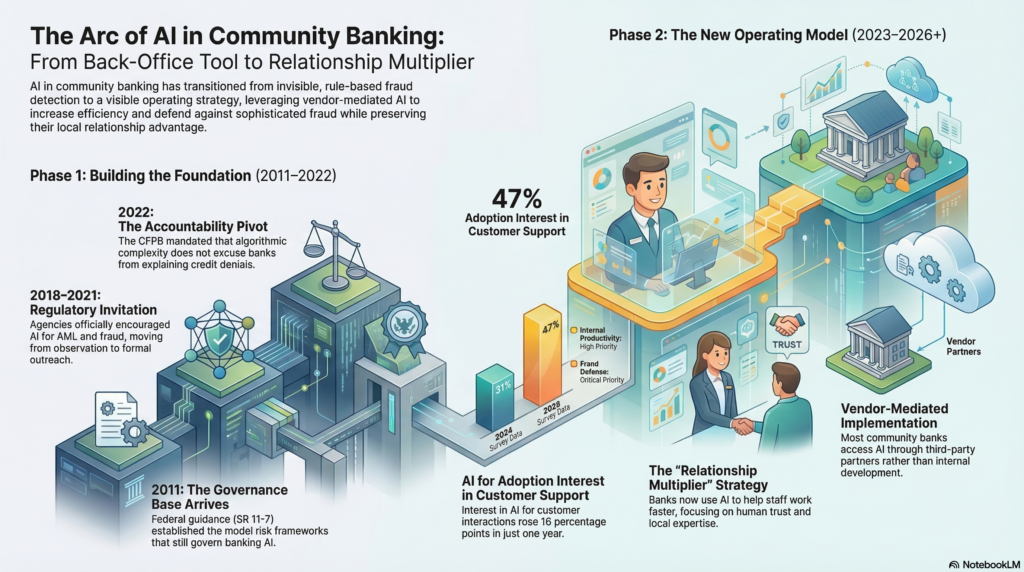
This episode traces that history in a practical way. We move from 1980s expert systems to the 1989 FICO model. Then we reach 1990s pattern recognition for money laundering detection. We also cover the 2011 SR 11 to 7 guidance. That framework still shapes model risk management today. So, community banking AI didn’t arrive overnight. It evolved quietly until generative systems pushed it into plain view.
Where the real pressure sits
The biggest challenge isn’t building custom models. Instead, it’s managing vendor dependence, legal exposure, and governance. Most community banks rely on core providers like Jack Henry, Fiserv, and FIS. Therefore, many institutions rent their technology rather than own it. That creates third party and fourth party risk. Even worse, the bank still carries the liability when systems fail. Community banking AI now depends as much on oversight as software.
Fraud is getting smarter
This episode also breaks down the new fraud landscape with unusual clarity. We look at deepfakes, voice cloning, and synthetic identity fraud. Criminals can now build fake profiles that appear trustworthy over time. Meanwhile, banks need AI to read behavior in context. That includes transaction velocity, device patterns, and geolocation. Because of that, community banking AI has become a defensive necessity, not a side project.
The human role gets stronger
The most useful lesson may be the simplest one. AI works best when it removes repetitive work from human bankers. We discuss case studies where voice assistants resolved more calls. We also cover lending tools that improved application conversion. Yet the deeper point stays consistent. Automation should give bankers more time for advice and relationship building. In that sense, community banking AI acts as a relationship multiplier, not a replacement.
A Summary of The History of AI in Community Banking
| Phase | Time Period | Key Technologies | Primary Use Cases | Operational Impact | Regulatory & Governance Context | Adoption Status (Inferred) |
|---|---|---|---|---|---|---|
| Proto-AI & Early Expert Systems | 1970s – 1990s | Rule-based expert systems, static algorithms, linear/logistic regression. | Automated cash dispensing (ATMs), basic credit scoring (FICO 1989), back-office batch processing. | Automated routine transaction posting and financial planning; reduced manual entry errors. | Traditional model risk management for regression; expert systems largely unregulated. | Foundational |
| Early Machine Learning Integration | 2000s – Early 2010s | Predictive analytics, neural networks for fraud, early cloud computing. | Card fraud detection, Anti-Money Laundering (AML) monitoring, online banking portals. | Shifted from reactive to predictive fraud detection; democratized compute power via cloud. | Federal Reserve/OCC SR 11-7 (2011) established modern model risk management foundation. | Emerging |
| Machine Learning Maturity & Visible AI | Mid-2010s – 2022 | Advanced ML (XGBoost, GBM), Natural Language Processing (NLP), early Chatbots. | Intelligent digital assistants, automated contract review, document routing, alternative data underwriting. | Significant reduction in transaction processing times (~23%) and operational errors (~31%). | Interagency Statement on AML Innovation (2018); focus on explainability and fair lending. | Selective Adoption |
| Generative AI & Strategic Imperative | Late 2022 – 2025 | Large Language Models (LLMs), Generative AI (GPT-4, Claude). | 24/7 virtual assistants (voice/chat), SAR narrative drafting, loan application triage, marketing content. | Tripled deployment rates; moved AI from back-office specialized tool to core operating model. | CFPB Circular 2022-03 (Adverse Action); Interagency RFI on AI (2021); AI-specific oversight outreach. | Accelerating |
| Agentic AI & Operational Autonomy | 2025 – Early 2026 | Agentic AI (Autonomous agents), multi-agent systems, RPA integration. | Autonomous collections (voice/SMS), end-to-end loan orchestration, real-time alert investigation. | Up to 90% reduction in loan abandonment; 75% call containment; human role shifts to agent oversight. | ICBA AI Task Force (2026); NIST AI Risk Management Framework; Treasury AI Lexicon. | Early Production |
| Future Outlook: Autonomous Finance | 2026 – 2035 (Forecast) | Quantum-AI integration, Tokenized Deposits, Stablecoins, Federated Learning. | Hyper-personalization, autonomous treasury management, digital asset custody, real-time risk simulation. | Total redefinition of banking work; 42% of roles redefined; 30-40% reduction in operating expenses. | GENIUS Act (Digital Assets); Post-quantum cryptographic standards; EU AI Act influence. | Forecasted |
What happens next?
We hope we’ve made the stakes clear. Banks that delay adoption risk falling behind quickly. Early adopters gain cleaner operations, stronger fraud defense, and better valuations. We also explore federated learning as a way to share model improvements without sharing raw customer data. So the future may reward institutions that pair execution with trust. That’s why community banking AI now shapes survival, not just efficiency.
If you want to know more about the history of AI in Community Banking and what’s in store based on current trends in the space we’ve got you covered! We’ve compiled a comprehensive intelligence report specifically for community bank leadership.
It covers the full history of AI in community banking, 40 confirmed deployed use cases, 15+ named case studies with verified results, a complete vendor reference matrix, regulatory guidance through early 2026, and a 90-day action plan broken down by role. Whether you’re bringing it to your next board meeting or using it to build your AI roadmap, it’s all in one place.